I was all set to post my stuffed cabbage recipe when I made this absolutely delicious and beautiful soup that I just had to share with you. My kids went crazy over it and I think its just perfect for Fall. I also think its healthy, but then again I think butter and whole milk are healthy. I'm old-school like that; plus, we are a very active family and our bodies need the wholesome fats.
My kids aren't big cauliflower fans and I didn't want to go through all of the trouble to make maklooba just to have them pick all of the vegetables out. Then I thought of this:
Cream of Cauliflower Soup
What you need:
One cauliflower
An onion
1/4 cup white flour
Nutmeg, ground allspice or (if you want to be a little wild and all "fusion cuisine" here) I have found a pinch of baharat makhloot pairs perfectly with the creamy vegetable flavors
Milk (as much as a quart)
1/2 stick (1/4 cup or about 25g) of butter
Reserved cauliflower liquid
Chicken broth
What you do:
If you're like me, you'll want to do this on a day when you're going to be dirtying another pot anyways because this soup is best when using two pots. I use the cauliflower pot to boil rice, corn, or stock.
Break up the cauliflower into florets and chop the stems. You may have to peel some of the fibrous outer layers off of the lowest stems, but don't throw them (the stems, that is)! Throw it all in a big pot and add water until it comes about halfway up the cauliflower. You want to cover and steam it with as little salted water as possible for a while, mashing it as you go along. If you boil it in a large amount of water, you're throwing out all of the vitamins and phytochemicals when you drain it! You can also do this in the microwave.
While your cauliflower is steaming, you can go ahead and make your white sauce. I always start my sauces and gravies with a roux. Take your half stick of butter and melt it over very low heat. When it is melted and starting to get bubbly, add a finely chopped onion and saute until it is soft and transparent but not colored. You can cover the pan to help the onion get done faster without coloring. Remove the onion and reserve. Add 1/4 cup of flour and saute with the butter, stirring all the while. Saute for a couple of minutes--you want the flour to start to get cooked (this will result in a smooth white sauce) but not colored (you want a white roux for a white sauce, not a brown roux for a brown gravy). Now, slowly add the milk still stirring all the while. It may seem to seize or lump up, but that's alright. We already cooked our flour, so those lumps will come right out with some vigorous wrist action. Add your milk slowly, occasionally pausing to stir vigorously until smooth. Stir it until it is thickened and bubbling. When your white sauce is at the consistency of gravy or, well, white sauce, then add salt, pepper, and a pinch of nutmeg or allspice.
Drain your cauliflower if there's a lot of liquid left, but reserve the liquid. If there is a very little liquid you don't need to drain it. Add your sauteed onions. Mash your onions and cauliflower with a potato masher as smooth as you can, it's easier if you drained it well. If you were a five star restaurant you could puree the vegetables in a food processor or blender for a completely smooth consistency but after child number three was born we let our rating slide and we don't want to wash the food processor any more (we obviously let or mind slide a bit as well, which is why we are calling ourselves "we"). Add chicken broth and any liquid left over from steaming your cauliflower to bring your mixture to your desired soup consistency. Reheat, but don't let it boil, and serve as soon as possible.
You can vary this recipe by using more milk for the liquid, using some cream or half and half instead of some of the liquid, or even adding some cheese to the white sauce (before you add the cauliflower or any additional liquid). You can also use this same recipe technique to make baked potato soup with leftover mashed or baked potatoes.
Recipes, reminiscence, and occasional tips on keeping house, raising kids, and staying fit and pretty. From a Muslim Mama.
Showing posts with label Recipes. Show all posts
Sunday, October 30, 2011
Saturday, October 8, 2011
Bamia (Caramalized Okra Stew)
You! Stop. Yes, you. You, right there staring blankly at the screen, ready to leave this page at the sight of the word okra. Or, stew.
Trust me, this one is a show stopper. You could even serve it to your boss. Or mother-in-law. It's that good.
Bamia (Arabic for okra) is an extremely popular vegetable in Shami cooking. In the summer it is used fresh; in the winter, dried.
Okra stew is served two ways in this region: as a thick stew over rice or caramalized in the oven and eaten with bread. When served with rice it is not unlike an Arabic gumbo and I can completely understand why true okra lovers are fond of it. When served hot from the oven with fresh pita bread it is a showstopper.
Another benefit of the caramalized version is that it is make ahead. You can make the stew (to be aunthentic, call it the maraqa) earlier in the day or even the day before and put it in the oven just before serving. If you are serving it as part of a guest meal I suggest individual dishes that you can stick under the broiler, if you are enjoying this as a family it can be broiled in a large shallow pan. Nowadays, I use the broiler pan that came with my oven; when my family was smaller I used to use a shallow 9"x 9" glass cake pan.
What you will need:
-Meat (Beef, Lamb, or Sheep). I personally use a little less than a pound per 1.5 pounds of okra. If your taste runs less or more, that's fine; but, if you use less you will need to use a richer stock or substitute stock for some of the water.
-Onions. I use one large one for my 1.5 pounds of okra
-Garlic- divided in two (I use about 2-3 full teaspoons of chopped garlic. This is about 2-3 cloves)
-Okra (as small as possible, left whole, with just the top trimmed off)
-4 or 5 very ripe tomatoes, peeled or not, chopped
-salt and black pepper to taste
- maggi, knorr, boullion powder, or fresh or canned stock (beef stock is best, but I've used Knorr chicken powder in a pinch)
-Baharat Makhloot (7 spice blend available in all middle eastern stores) and/or a scant handful of Allspice berries (or ground allspice)--I prefer just a scant teaspoon of Baharat and a small handfull of Allspice berries as they let the complex flavors of the dish shine through. If you don't like picking whole spices out of your food, use a cheesecloth bundle or 2 heaping teaspoons of ground Baharat.
-fresh or whole dried hot pepper or ground dried hot pepper (or both fresh and dried) (I use a single one of the light green, elongated, mildly hot variety or about 1/2 teaspoon of ground red hot pepper)
- one or two bay leaves
-carob syrup (in Middle Eastern stores as Dibs Kharoub) or tamarind "dibis"/syrup (Also Middle Eastern Stores as "Tamar Hindi"). You can also use frozen tamarind puree (available in the frozen Latin section) and honey (I've even used honey alone in a pinch). When I'm in the US I use tamarind as it's more readily available at regular supermarkets.
-coriander (cilantro) leaves, chopped finely (about a small bunch or half a large bunch, or to taste)
It is nice to fry/ saute the okra before adding them, but I often skip this when I am pressed for time. In order to save a pan, I do this before anything else, then remove and reserve them.
Saute the onions in plenty of olive oil (you want to at least comfortably coat the bottom of your pot, if any of your ingredients start to stick, add more!). When the onions have started to soften, add any fresh peppers. Saute until peppers are soft then add half of the garlic and saute for a bit, until the aroma rises. Add the meat, tossing to brown all sides. When the meat is browned, add any ground spices that your using and the chopped tomatoes. Add pepper and dried red pepper to taste. Add some salt, but not all, you want to take into account the saltiness of your stock as well as "save" some to saute with the garlic and coriander at the end. Some salt is necessary to draw out the flavors of the meat and vegetables at this point, however.
When the tomatoes have cooked down into a sauce and the meat is tender, add the okra and just a little stock (or water and powder) as nessasary (just enough so the okra doesn't burn). You want to braise the okra more than boil it at this point. As the okra cooks, keep adding a bit more stock each time you check. The more it cooks, the more you'll want to add more and more stock so that you make a sauce. If you run out of stock, don't worry about it--just use water or your powdered stock. Add whole spices and bay leaves, adjust seasoning to your tastes. When the seasoning is good add a generous tablespoon of tamarind syrup or frozen puree (i use about a fifth of the frozen packet and 2 teaspoons of honey). You can add more honey/ syrup if you like. It should not taste noticeably sweet, but rather the honey or dibs will contribute to a depth of flavor.
When the stew is done, saute the reserved garlic in some salted olive oil until the aroma rises, but it is not quite golden yet. Add the cilantro and saute for a second, remove from the heat, and pour into the stew.
You can do this all as far ahead of time as you like. I do it early (even the evening before if I have a busy day ahead of me) and clean the kitchen.
When you are ready to serve, pour it into a pan that a) you can put under the broiler and b) you can eat from. Broil until the stew is bubbly and starting to caramalize and serve in the same pan with pita bread (or moroccan bread or ciabatta any other bread that you can use to scoop out stew--much like the way you scoop dip with a chip). I'll serve my kids from a plate, but trust me this one is nicer (and prettier) right out of the dish you broiled it in.
Trust me, this one is a show stopper. You could even serve it to your boss. Or mother-in-law. It's that good.
Bamia (Arabic for okra) is an extremely popular vegetable in Shami cooking. In the summer it is used fresh; in the winter, dried.
Okra stew is served two ways in this region: as a thick stew over rice or caramalized in the oven and eaten with bread. When served with rice it is not unlike an Arabic gumbo and I can completely understand why true okra lovers are fond of it. When served hot from the oven with fresh pita bread it is a showstopper.
Another benefit of the caramalized version is that it is make ahead. You can make the stew (to be aunthentic, call it the maraqa) earlier in the day or even the day before and put it in the oven just before serving. If you are serving it as part of a guest meal I suggest individual dishes that you can stick under the broiler, if you are enjoying this as a family it can be broiled in a large shallow pan. Nowadays, I use the broiler pan that came with my oven; when my family was smaller I used to use a shallow 9"x 9" glass cake pan.
What you will need:
-Meat (Beef, Lamb, or Sheep). I personally use a little less than a pound per 1.5 pounds of okra. If your taste runs less or more, that's fine; but, if you use less you will need to use a richer stock or substitute stock for some of the water.
-Onions. I use one large one for my 1.5 pounds of okra
-Garlic- divided in two (I use about 2-3 full teaspoons of chopped garlic. This is about 2-3 cloves)
-Okra (as small as possible, left whole, with just the top trimmed off)
-4 or 5 very ripe tomatoes, peeled or not, chopped
-salt and black pepper to taste
- maggi, knorr, boullion powder, or fresh or canned stock (beef stock is best, but I've used Knorr chicken powder in a pinch)
-Baharat Makhloot (7 spice blend available in all middle eastern stores) and/or a scant handful of Allspice berries (or ground allspice)--I prefer just a scant teaspoon of Baharat and a small handfull of Allspice berries as they let the complex flavors of the dish shine through. If you don't like picking whole spices out of your food, use a cheesecloth bundle or 2 heaping teaspoons of ground Baharat.
-fresh or whole dried hot pepper or ground dried hot pepper (or both fresh and dried) (I use a single one of the light green, elongated, mildly hot variety or about 1/2 teaspoon of ground red hot pepper)
- one or two bay leaves
-carob syrup (in Middle Eastern stores as Dibs Kharoub) or tamarind "dibis"/syrup (Also Middle Eastern Stores as "Tamar Hindi"). You can also use frozen tamarind puree (available in the frozen Latin section) and honey (I've even used honey alone in a pinch). When I'm in the US I use tamarind as it's more readily available at regular supermarkets.
-coriander (cilantro) leaves, chopped finely (about a small bunch or half a large bunch, or to taste)
It is nice to fry/ saute the okra before adding them, but I often skip this when I am pressed for time. In order to save a pan, I do this before anything else, then remove and reserve them.
Saute the onions in plenty of olive oil (you want to at least comfortably coat the bottom of your pot, if any of your ingredients start to stick, add more!). When the onions have started to soften, add any fresh peppers. Saute until peppers are soft then add half of the garlic and saute for a bit, until the aroma rises. Add the meat, tossing to brown all sides. When the meat is browned, add any ground spices that your using and the chopped tomatoes. Add pepper and dried red pepper to taste. Add some salt, but not all, you want to take into account the saltiness of your stock as well as "save" some to saute with the garlic and coriander at the end. Some salt is necessary to draw out the flavors of the meat and vegetables at this point, however.
When the tomatoes have cooked down into a sauce and the meat is tender, add the okra and just a little stock (or water and powder) as nessasary (just enough so the okra doesn't burn). You want to braise the okra more than boil it at this point. As the okra cooks, keep adding a bit more stock each time you check. The more it cooks, the more you'll want to add more and more stock so that you make a sauce. If you run out of stock, don't worry about it--just use water or your powdered stock. Add whole spices and bay leaves, adjust seasoning to your tastes. When the seasoning is good add a generous tablespoon of tamarind syrup or frozen puree (i use about a fifth of the frozen packet and 2 teaspoons of honey). You can add more honey/ syrup if you like. It should not taste noticeably sweet, but rather the honey or dibs will contribute to a depth of flavor.
When the stew is done, saute the reserved garlic in some salted olive oil until the aroma rises, but it is not quite golden yet. Add the cilantro and saute for a second, remove from the heat, and pour into the stew.
You can do this all as far ahead of time as you like. I do it early (even the evening before if I have a busy day ahead of me) and clean the kitchen.
When you are ready to serve, pour it into a pan that a) you can put under the broiler and b) you can eat from. Broil until the stew is bubbly and starting to caramalize and serve in the same pan with pita bread (or moroccan bread or ciabatta any other bread that you can use to scoop out stew--much like the way you scoop dip with a chip). I'll serve my kids from a plate, but trust me this one is nicer (and prettier) right out of the dish you broiled it in.
Tuesday, October 4, 2011
Cooking in the Sham Region
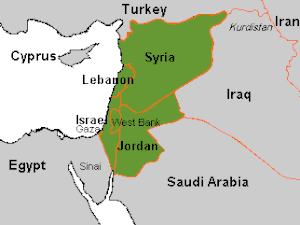
Many of the recipes I will be posting have their origins in the Sham region of the Middle East. To Westerners, the Sham region in variously known as the Near East and the Levant. Shami cooking is comprised of the dishes traditionally made in Syrian, Palestinian, Jordanian, and Lebanese homes and restaurants.
Shami cooking can be intricate and time consuming, but it can also be simple and quick. There is a great emphasis on the importance of nutrition in the culture and children are still fed a hot meal upon arriving home from school. "Citified" versions of dishes, like those made in Beirut and Damascus, are more delicate and refined. A Palestinian version is often hearty and rustic--designed to fill the bellies of the farmers arriving home after a day working their famous farmlands in one of the most fertile areas of the Middle East. Like Boston's famous baked beans or Maryland's crab cakes there are some specialties belong to a more specific area in this region, but even those have now been adopted by neighbors.
The cooking of this region is typified by a few ingredients that are considered exotic to the average Westerner. Other ingredients, such as yogurt, are ubiquitous in the West but used in different ways.
I will keep an ongoing glossary page where I describe or define ingredients and non-English terms.
If you are truly interested in learning to make Shami foods, I suggest you find a good Middle Eastern or Greek market where you can find fresh spices and other ingredients.
For my Middle Eastern and especially my Shami readers, bear with me--I think you may be pleasantly surprised. As I am neither Shami nor Arab, I have been freed from many of the constraints you are bound by. I can take tips from my closest Syrian friends, temper with American ingenuity, and apply them to the Palestinian dish that is the staple at my mother in law's house. Sometimes this results in disaster, but on other occasions I have produced a meal that is guaranteed to knock your socks off!
Tuesday, July 26, 2011
Southern Style Coleslaw
photo courtesy of everystockphoto.com 1 Ever notice that your homemade coleslaw never tastes quite as good as the slaw from your favorite BBQ restaurant? Not anymore! The secret is using an old-fashioned cooked salad dressing as well as mayonnaise. Go ahead and have your favorite grill-master get the (beef) ribs ready--its BBQ tonight! What you need: 1 head cabbage (red cabbage looks very pretty in this dish, though green in more traditional) 1/2 medium onion (or more, if you like) 1-2 carrots (omit if using red cabbage) 1 egg 1/4-1/3 cup (60-80 ml) sugar (depending on how sweet you like your slaw) 1/4-1/3 cup (60-80) white or apple cider vinegar (amount depends on how tangy you like your slaw) 3/4 to 1 scant tsp salt 1/2 tsp black pepper or less 1 Tbs flour mayonnaise to taste (I usually use an equal ratio of mayonnaise to cooked dressing) mustard to taste (Optional. I've lately been using a spoonful of fresh ground mustard seed and am thrilled with the results. You can use your favorite bottled mustard) 1 Tbs celery seed (optional) Paprika for garnish (optional) What you do: Slice your cabbage using a knife or the slicing (not shredding) blade of your food processor. If your machine comes with two blades, use the larger. Shred the carrots with the larger blade Slice, chop, or shred your onions (I prefer mine sliced very fine. I use the smaller slicing blade on my processor. Its worth cleaning two blades to me) Mix together in the serving/storage bowl you will be using remembering that the salad will shrink in volume as the vegetables soften. Use a bowl that is big enough to toss and mix the salad but not so big that you will be wasting space. In a small saucepan beat your egg with the sugar. Sprinkle the flour, salt, pepper, and ground mustard if using evenly over the egg mixture and beat in. Beat in the vinegar. Cook and stir on low heat until the mixture thickens--it may begin to "plop" as well. If it hasn't thickened in a few minutes, just turn the heat up to medium low stirring all the while. When completely cooled add mayonaisse and bottled mustard and celery seed if using (all to taste). Mix with the cabbage and chill until the vegatables have softened. Garnish with paprika if desired. |
1. http://www.everystockphoto.com/photo.php?imageId=11138748&searchId=5c51492941376641d7bfc2d45bf157dc&npos=162↩
Sunday, July 24, 2011
Cook Like You
I'm going to teach you how to cook like you.
What do I mean "cook like you"? Why didn't I say "cook like me" or "cook like a pro" or "cook like Nigella Lawson"? Well, I can't teach you to cook like me any more than I can teach you to dress like me, act like me, or look like me. Like a perfume wears differently on each person, every dish is different depending on who makes it. In fact, some of you might know that perfume can even smell differently on the same person depending on mood, hormonal balance, or even weather. Real cooking is like that. It's what makes a five star-chef owned restaurant or an amazing family owned and operated Italian joint different from a national chain. Real cooking has personal flair, like fashion or make-up or decorating. Real cooks often don't follow recipes, though they might if the dish is unfamiliar or has a complicated spice list.
I will be sharing some recipes with perfect and precise ingredient lists and, let me tell you, you had better appreciate those. I am truly a spoonful of this--taste, taste--pinch of that--taste taste--"Ahh, yes!" kind of cook and for these exact measurement recipes I had to force myself to catch each pinch and handful with a proper measuring spoon.
But there will also be recipes with no measurements more than "a handful of, a little bit of, a big pinch of, a little pinch of". Those are the really valuable recipes, the ones "like Mama used to make". Don't worry, you can do it.
Sometimes you will be able to go out and taste a good and authentic example of what you are trying to make. When you are eating, immerse yourself in the experience. Don't necessarily try to pick apart the different spices, as that is something that takes time, but do try to get a feeling for the experience of what you are eating. Then, when you work on that dish in your own home, you will be able to say, "Now, that's biryani!" Your biryani will probably never taste the same as any other biryani you ever had--and it shouldn't--but it should be recognizably biryani.
Other times, I will teach you to make things that rarely can be found outside a home. These are family style meals. They are either not considered fancy enough to serve at restaurants or don't work well in a restaurant environment (see note 1 ) Unless you have a dear friend who shares the same cultural heritage as the dish I'm teaching you, it's going to be difficult to find a good example of those types of foods. But don't worry, I'm going to hold your hand. I'm going to immerse you in Mama Hen's kitchen. I'm going to let you smell and taste the food til your hearts content. When we're done, you're going to be able to get out there and make some real food.
So, go on over on to you tube and watch your favorite Sesame Street clip or Barney episode or whatever you used to watch. Pretend you're eight years old again. Pull up a chair so you can reach the stove and get ready to listen to Mama. I'm going to teach you how to be a real cook. I'm going to teach you how to cook like you.
1. risotto, for example, is a delicious and beautifully presented Italian rice dish, but it doesn't hold well and as such is difficult to serve in a restaurant. You will typically only find risotto at individually owned Italian restaurants where it is made to order for the individual customer.
What do I mean "cook like you"? Why didn't I say "cook like me" or "cook like a pro" or "cook like Nigella Lawson"? Well, I can't teach you to cook like me any more than I can teach you to dress like me, act like me, or look like me. Like a perfume wears differently on each person, every dish is different depending on who makes it. In fact, some of you might know that perfume can even smell differently on the same person depending on mood, hormonal balance, or even weather. Real cooking is like that. It's what makes a five star-chef owned restaurant or an amazing family owned and operated Italian joint different from a national chain. Real cooking has personal flair, like fashion or make-up or decorating. Real cooks often don't follow recipes, though they might if the dish is unfamiliar or has a complicated spice list.
I will be sharing some recipes with perfect and precise ingredient lists and, let me tell you, you had better appreciate those. I am truly a spoonful of this--taste, taste--pinch of that--taste taste--"Ahh, yes!" kind of cook and for these exact measurement recipes I had to force myself to catch each pinch and handful with a proper measuring spoon.
But there will also be recipes with no measurements more than "a handful of, a little bit of, a big pinch of, a little pinch of". Those are the really valuable recipes, the ones "like Mama used to make". Don't worry, you can do it.
Sometimes you will be able to go out and taste a good and authentic example of what you are trying to make. When you are eating, immerse yourself in the experience. Don't necessarily try to pick apart the different spices, as that is something that takes time, but do try to get a feeling for the experience of what you are eating. Then, when you work on that dish in your own home, you will be able to say, "Now, that's biryani!" Your biryani will probably never taste the same as any other biryani you ever had--and it shouldn't--but it should be recognizably biryani.
Other times, I will teach you to make things that rarely can be found outside a home. These are family style meals. They are either not considered fancy enough to serve at restaurants or don't work well in a restaurant environment (see note 1 ) Unless you have a dear friend who shares the same cultural heritage as the dish I'm teaching you, it's going to be difficult to find a good example of those types of foods. But don't worry, I'm going to hold your hand. I'm going to immerse you in Mama Hen's kitchen. I'm going to let you smell and taste the food til your hearts content. When we're done, you're going to be able to get out there and make some real food.
So, go on over on to you tube and watch your favorite Sesame Street clip or Barney episode or whatever you used to watch. Pretend you're eight years old again. Pull up a chair so you can reach the stove and get ready to listen to Mama. I'm going to teach you how to be a real cook. I'm going to teach you how to cook like you.
1. risotto, for example, is a delicious and beautifully presented Italian rice dish, but it doesn't hold well and as such is difficult to serve in a restaurant. You will typically only find risotto at individually owned Italian restaurants where it is made to order for the individual customer.
Subscribe to:
Posts (Atom)